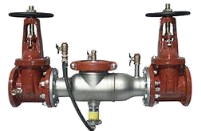
Reduced Pressure Zone Assembly (RPZ, RP, RPBA, RPPA)
Health hazardBacksiphonage + backpressureTestable assembly- Protects againstBacksiphonage and backpressure, high (health) hazard
- PartsTwo independent spring-loaded check valves, a hydraulically operated relief valve between them, two shutoffs, four test cocks
- Where requiredAny health-hazard connection: medical/dental/vet, restaurants with chemical feed, car washes, labs, manufacturing, irrigation with fertilizer injection, private wells on city water, boilers with chemical treatment, fire lines with antifreeze or foam
- InstallationHorizontal (most models), minimum 12 in. above grade or flood level, never in a pit or vault that can flood, needs a drain that can take full relief-valve discharge, protected from freezing
- Test criteria (USC)Check #1 holds ≥ 5.0 psid; check #2 holds ≥ 1.0 psid; relief valve opens at ≥ 2.0 psid
The RPZ is the highest level of mechanical protection. Between its two checks is the zone of reduced pressure: a chamber deliberately held a few psi below supply pressure. If either check leaks, or pressure reverses, the relief valve opens and dumps water out of the zone to atmosphere — so the contaminated water goes on the ground, not into the main. That discharge is a feature, not a defect, but it is also why an RPZ can never go where the discharge could flood something.
Because it is spring-loaded and held under a pressure differential, an RPZ costs a few psi of pressure and, on a large domestic service, that matters for sizing. It also dribbles briefly during normal pressure fluctuations; a steady stream from the relief port means a fouled first check or a failed relief valve and it needs service.